
About this service
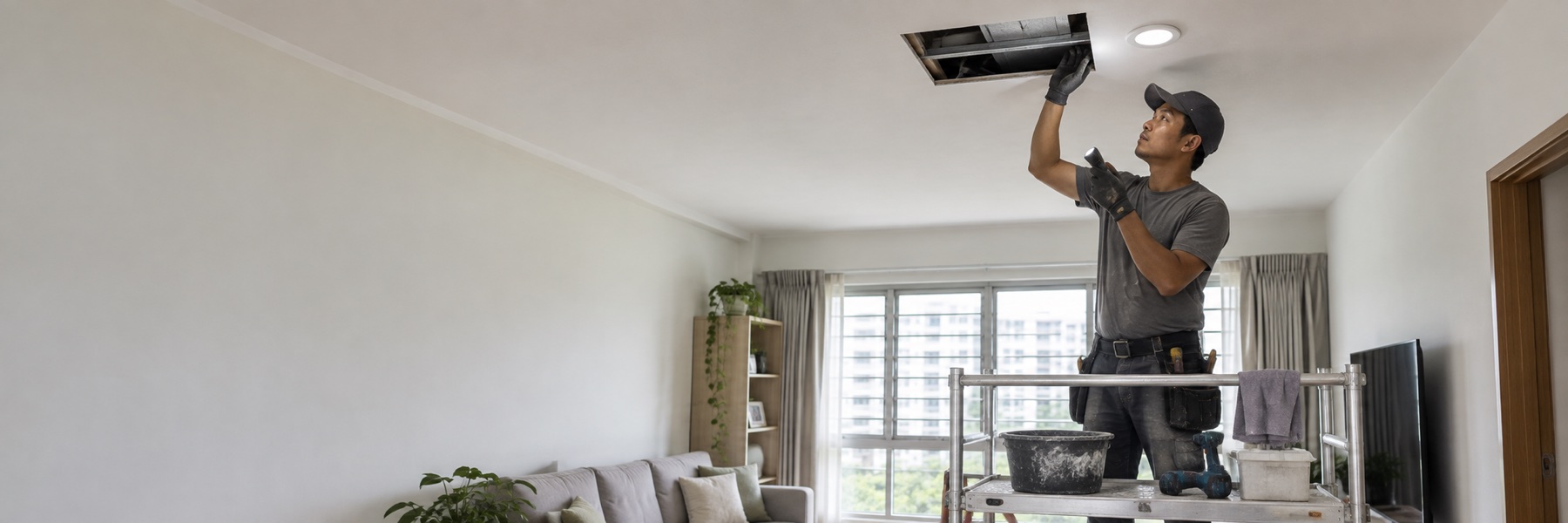
A damaged false ceiling can affect the appearance, comfort and safe use of a room. Cracks, holes, stains, sagging sections and damaged boards can also indicate that something above the ceiling needs attention. Apex Ceilings provides false ceiling inspection and repair for residential and commercial properties across Singapore. Our team assesses the visible damage, checks the accessible surrounding area and explains whether a local repair, board replacement or wider ceiling replacement is the more practical option.
Repair work should restore more than the surface appearance. The repaired area must be properly supported, neatly joined and prepared so the finished ceiling sits naturally with the surrounding section. Where damage follows plumbing, air-conditioning, electrical or other work above the ceiling, we coordinate the ceiling opening and reinstatement with the relevant trade. An active source of moisture or service fault should be resolved before the final ceiling finish is completed.
Ceiling problems we repair
Cracks and joint lines
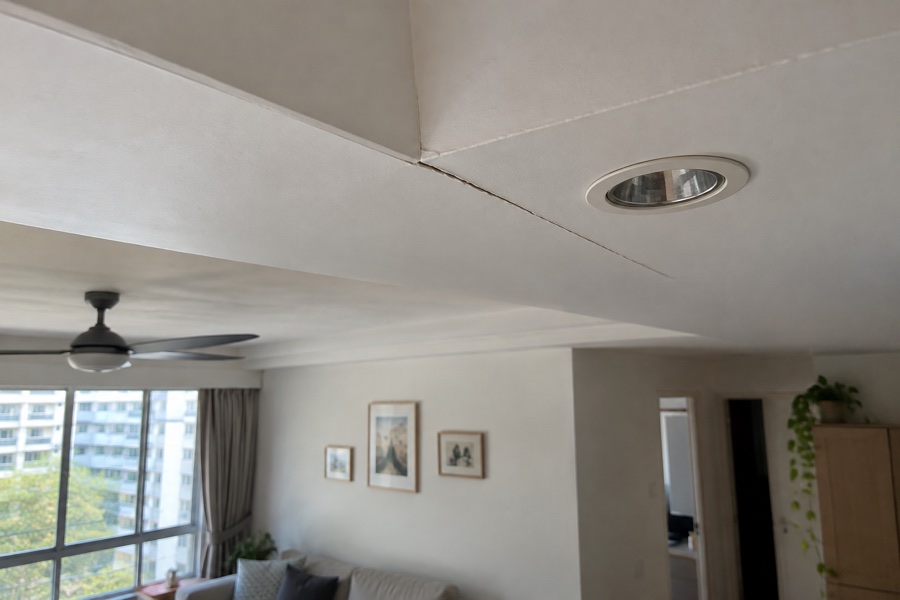
Fine cracks may follow a joint or appear around openings and fixtures. We inspect the location and movement before deciding whether joint treatment, patching or board replacement is appropriate.
Holes and access openings
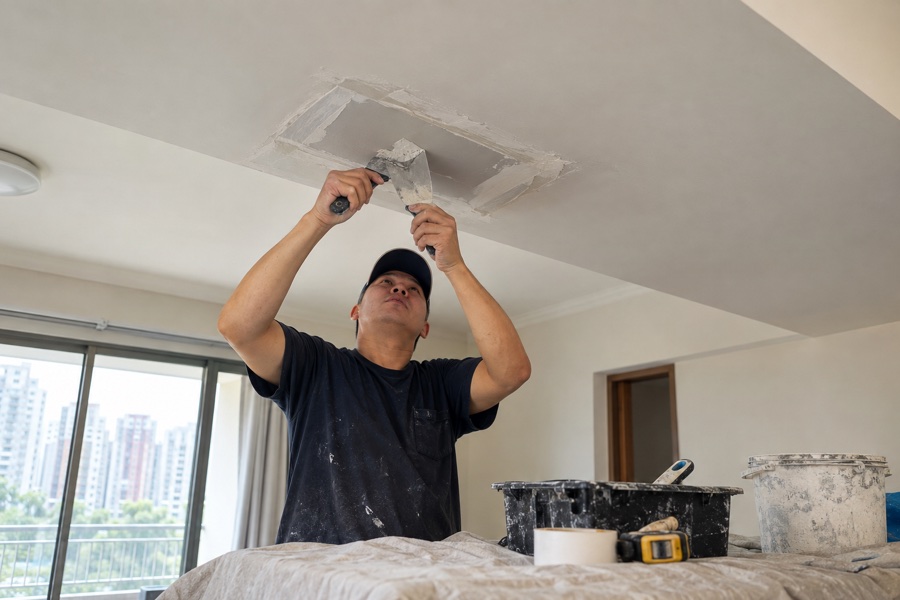
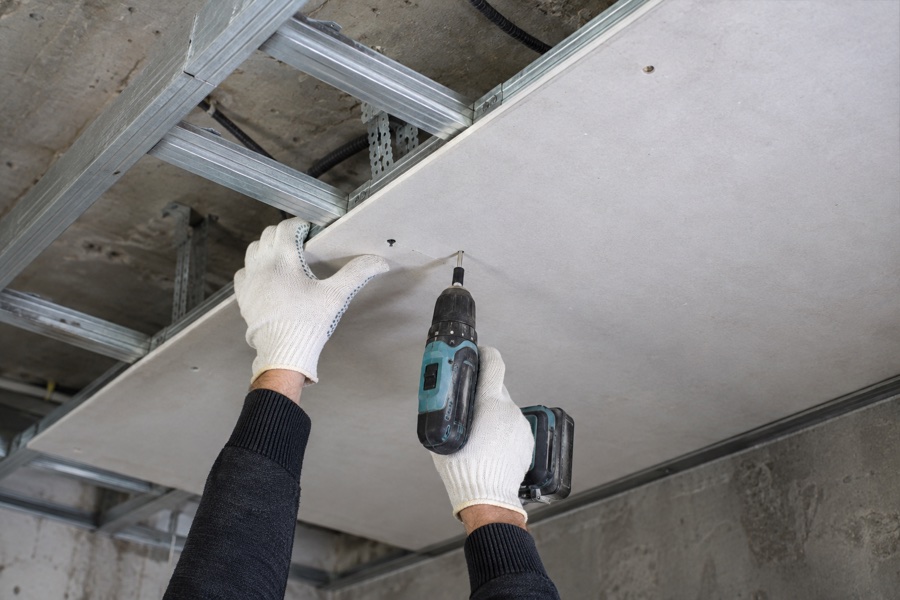
Ceilings are sometimes opened to reach pipes, wiring or air-conditioning services. We can reinstate the opening, provide the required support and finish the surface for painting.
Water stains and soft boards
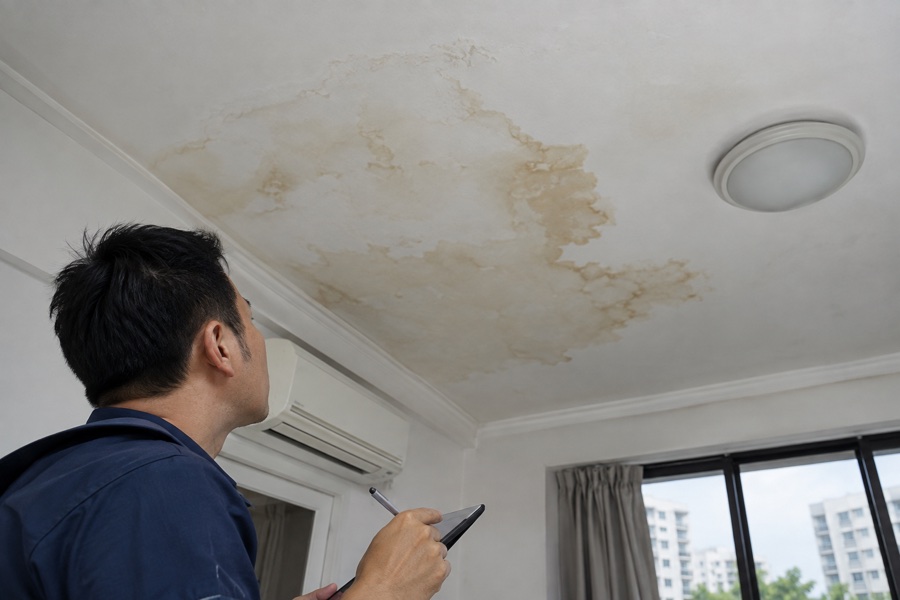
Discolouration, bubbling paint or softened plasterboard can follow a leak or prolonged condensation. The moisture source must be addressed before damaged material is replaced.
Sagging or uneven sections
A visibly uneven ceiling can involve the board, joints or support system. We assess the affected area rather than treating sagging as a cosmetic paint problem.
Peeling and damaged finishes
Peeling paint or a rough previous patch can make an otherwise sound ceiling look neglected. We prepare and level the affected surface before the finishing stage.
Damage around lights and vents
Cut-outs can chip or widen during fixture changes. We repair the surrounding board and coordinate suitable openings for the final fitting.
Assessment before repair
We begin by discussing what happened, when the damage appeared and whether any plumbing, air-conditioning, electrical or renovation work took place nearby. The team then checks the accessible ceiling surface, edges, joints, openings and surrounding area. This helps separate an isolated cosmetic defect from damage that calls for a larger replacement. We explain the proposed scope before work begins so the customer understands what will be opened, retained and restored.
Local patching or board replacement
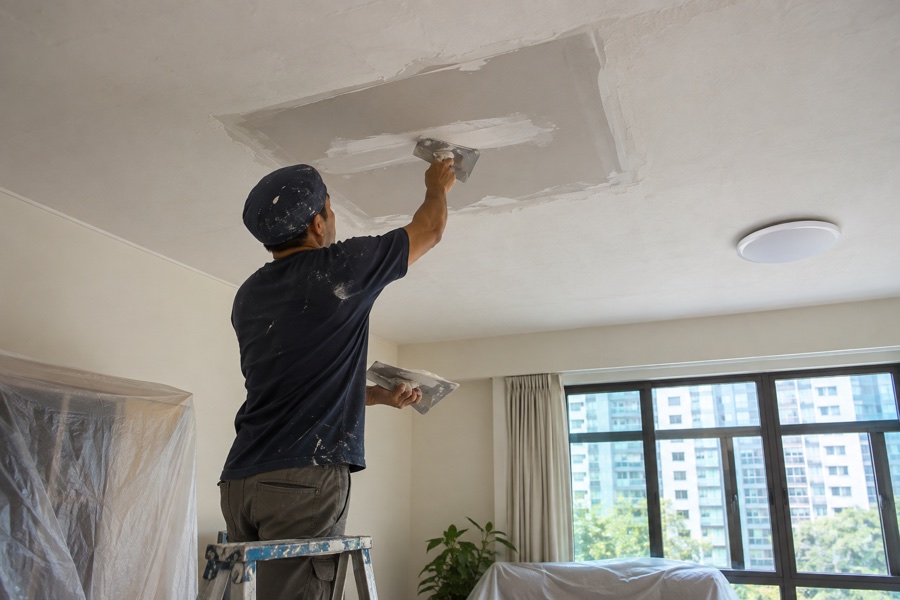
Small, stable openings may be repaired locally when the surrounding board and support remain suitable. Soft, badly cracked or extensively damaged material is usually better removed back to a sound edge and replaced. The new section is secured, joints are treated and the surface is prepared for a consistent finish. Where a large part of the ceiling has deteriorated, we will recommend replacement instead of building a series of unreliable patches.
Repair after service access
Contractors may need access above a false ceiling to repair wiring, pipes, ducts or equipment. We can plan a controlled opening and reinstate it after the service work is complete. If future inspection is likely, an appropriate access panel may be considered rather than repeatedly cutting the ceiling. The final position and size depend on the services, ceiling construction and room layout.
Finishing and coordination
A technically sound patch should also look tidy. We align the repaired section with the surrounding ceiling, treat joints and prepare the surface for painting. Colour matching depends on the age and condition of the existing finish, so repainting a wider area may sometimes give a more even result. Our team can coordinate ceiling work with lighting and electrical items within the agreed project scope.
What we check above and around the damage
The visible mark is only one part of the assessment. We consider whether the ceiling is a continuous plasterboard system or a removable tile system, how the affected board is supported, and whether nearby joints or fixings have also moved. We also look at the relationship with lights, grilles, access panels, curtain pelmets and wall junctions. If the original support cannot be confirmed without opening the ceiling, the quotation can allow for inspection before the final repair method is settled. This avoids promising a small patch where the surrounding material may no longer provide a reliable fixing point.
Different causes need different responses
An impact hole, a plumbing access opening and a long-term moisture stain should not receive the same treatment. Impact damage may be limited to the board face, while service access may leave cut edges that need new support. Moisture can affect paper facing, joint compound, paint and insulation even after the surface feels dry. Cracks may relate to a failed joint, movement at a junction or an earlier repair. Identifying the likely cause helps us select a repair that suits the condition instead of applying filler to every defect.
Protecting the room during repair
Ceiling repair involves cutting, jointing and surface preparation above the occupied area. Before work begins, furniture and loose items should be moved away where practical. Floors and retained finishes are protected within the work zone, and dust is controlled as the damaged section is opened and prepared. Access must also remain safe for ladders and materials. In shops or offices, the working period can be coordinated around customer activity and building access, subject to the project’s size and site rules.
What the repair does and does not solve
Our ceiling work restores the agreed board, support and finish. It does not replace the need for the relevant specialist to resolve an active roof, plumbing, drainage or air-conditioning leak. Likewise, a ceiling repair cannot certify concealed building services that are outside the visible and agreed work area. We identify concerns that become apparent during the repair and discuss any change in scope before proceeding. This keeps the ceiling work clear and prevents a neat surface from being mistaken for a repair to an unrelated underlying fault.
Aftercare for the repaired ceiling
Once the repair and finish are complete, avoid pressing, drilling or hanging loads from the repaired board without confirming a suitable support point. Monitor any area that was previously affected by moisture, especially after heavy rain or operation of the relevant plumbing or air-conditioning system. If a mark, crack or soft area returns, contact the source contractor as well as the ceiling team. Early investigation is more useful than repeatedly painting over a symptom.
Working with Apex Ceilings
Ceiling and partition work is easiest to control when measurements, materials, interfaces and finishing expectations are agreed before installation. We discuss the intended result in plain terms, review the accessible site conditions and prepare a scope for the actual property. If the work forms part of a larger renovation, we coordinate our sequence with the interior designer, main contractor or other appointed trades. Any change discovered after opening an existing surface is raised before additional work proceeds.
As a direct contractor, Apex Ceilings uses its own ceiling and partition installers and maintains direct communication with the customer. This gives the team control over setting out, installation and finishing while avoiding an additional middleman layer. Our experience covers HDB flats, condominiums, landed homes, offices and other commercial interiors. The method and programme are adjusted to the site instead of treating every room as an identical package.
Workmanship also depends on what happens at the edges: a straight junction with the adjoining wall, correctly planned openings, clean corners and sufficient preparation before paint. We check these visible details as the work progresses. Customers should inspect the completed scope at handover and raise any question while the work area remains accessible. For later drilling, mounting or service access, use suitable fixing points and avoid assuming that the finished board alone can support a heavy load.
To request a quotation, send clear photographs, approximate dimensions, the property type and a short description of the intended work. Plans or marked-up images are helpful when several rooms or new partitions are involved. We may arrange a site visit where levels, concealed conditions, access or coordination cannot be confirmed remotely. The final quotation reflects the measured scope, selected system, finishing requirements and practical site arrangements.
How the work proceeds
- Share photos and describe the damage
- Arrange an inspection where the cause or extent is unclear
- Confirm repair, replacement and finishing scope
- Protect the work area and remove unsound material
- Rebuild, joint and prepare the repaired section
- Inspect the completed ceiling with the customer
A clear scope helps ceiling and partition work move smoothly. Timing depends on the area, access, site restrictions, drying between finishing stages and coordination with other trades. We confirm the expected programme for the actual project instead of applying one fixed duration to every job.
Planning a quotation
Photos and approximate measurements are useful for an initial discussion, but final scope may require a site assessment. Tell us the property type, affected rooms, intended use, preferred finish and any known service work. For commercial premises, include access hours and building-management requirements. The quotation will describe the agreed work, materials and exclusions so that responsibilities are clear before installation begins.
Apex Ceilings is a direct ceiling and partition contractor with more than ten years of industry experience. Our own installers allow us to coordinate workmanship and respond directly to customers, interior designers and project teams without an additional contracting layer.
Related services
For a new ceiling layout or a larger replacement, visit our false ceiling installation page. We also repair damaged drywall and plasterboard partitions.
Related guidance
If a repair becomes a wider replacement in an HDB flat, check the current HDB false ceiling requirements before finalising the scope. For a new layout, see our HDB false ceiling service; for walls opened during the same project, see partition wall repair.
Frequently Asked Questions
Can a hole in a false ceiling be patched? | Yes. If the surrounding board and support are sound, the opening can often be rebuilt, jointed and prepared for painting. Larger or irregular damage may require replacement back to stable edges. |
Do you repair ceilings damaged by water? | Yes, after the active leak or moisture source has been identified and resolved. We assess which boards and finishes need replacement rather than covering damp or softened material. |
Will the repaired area match the existing ceiling? | We level and prepare the repair to blend with the surrounding surface. An older paint finish may have faded, so a wider repaint can be advisable for the most even colour. |
Can you reinstate a ceiling after plumbing or electrical work? | Yes. We can repair an access opening after the other trade has completed its work and confirmed that the area can be closed. |
When should a ceiling be replaced instead of patched? | Replacement is usually more practical when damage is widespread, boards are soft or sagging, support is unsuitable, or repeated patches would not provide a dependable finish. |